Czech Business Today
Czech Industry Warns: Rushing the 2040 Climate Target Risks Deindustrialization, Not Decarbonization
Czech businesses are issuing a sharp warning to the EU: the current trajectory towards 90% emissions cut by 2040 is not a path to decarbonization, but a highway to deindustrialization. A recent, sobering analysis finds that this target, compared to early 1990s levels, demands a quantum leap that forces companies to skip three to four innovation cycles at an unsustainable pace. The cost is devastating, driving up both investment and operating expenses at a time when Central European firms are already paying dangerously high energy prices, threatening to price Czech production out of the global market entirely. The conclusion is clear: an overly rapid transformation is pushing industrial production towards decline and its eventual relocation outside of Europe.
The core challenge lies in relying on technologies that are simply not ready for prime time. The required massive rollout of RFNBO (renewable hydrogen fuels) is stalled by economics, with costs around a prohibitive €15/kg deterring long-term customer commitment. Similarly, Carbon Capture and Storage (CCS), crucial for cement and metallurgy, remains largely trapped in pilot projects. There is no working, predictable ecosystem—no transport networks, no storage sites, and no commercial reliability at scale. Investing in such immature technology, while facing an existential deadline, is financially indefensible. The price of the EU ETS allowance, often soaring around €80/ton, acts as a wrecking ball, prematurely destroying reliable conventional power sources before zero-emission alternatives are ready.
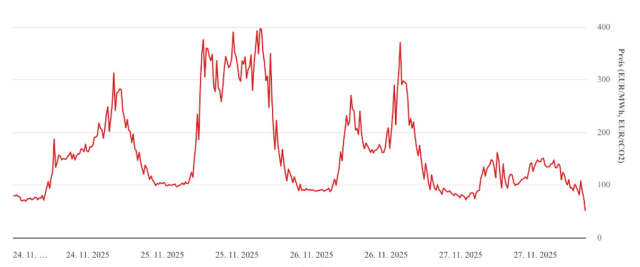
The economic strain is already acute. This pressure is evident in the energy sector’s struggle, as seen in the extreme price volatility of recent spot markets (illustrated below). This unstable, high-cost environment, exacerbated by flawed market models, particularly punishes energy-intensive sectors like chemicals, glass, and metallurgy, placing them directly in the crosshairs of “liquidation requirements.” The required total investment for transformation, grid doubling, and massive renewable build-out is estimated at 3.8 trillion CZK—a sum that completely dwarfs current available EU funding. This cost tsunami, along with the high energy demands of electrification, will further inflate the cost of electricity, which is already excessive for industry. Furthermore, the grim reality is that, due to the high ETS allowance price, reliable domestic coal-fired power generation is profitable only during the fourth and first quarters of the year, while generating unsustainable losses for the remainder, directly undermining energy security.
To steer away from this path of self-sabotage, Czech businesses urge Brussels to adopt realism: The transformation must embrace technological neutrality, directing public funds towards the most effective CO2 abatement projects—namely, large industrial projects and utility-scale renewables—not diverted to less impactful residential or niche sectors. To facilitate real investment, member states must accelerate the depreciation of decarbonization projects and drastically simplify permitting processes for all critical infrastructure, including CCS and large-scale renewables, which currently take far too long to approve. Furthermore, the EU must be judicious about its trade policy: it is paramount to fully evaluate the effectiveness of the CBAM (Carbon Border Adjustment Mechanism) before cancelling free ETS allowances. Premature cancellation creates a crippling double burden: European exporters pay high carbon costs while receiving no compensation against cheap imports, directly incentivizing carbon leakage and deindustrialization. The EU should also consider implementing permit expiration or holding limits to correct market manipulation. The message is unambiguous: the EU must choose stability and smart investment over unattainable speed. Protecting Europe’s industrial strength must be the foundation of climate policy, not its unintended sacrifice.
Source: Confederation of Industry and Transport of the Czech Republic + (Illustrative chart: Spot electricity prices this week.)